Regulatory Influences on Result Variability in Britain's Licensed Chance Gaming Sector
David Ludwig · Aug 30, 2026

Regulatory Influences on Result Variability in Britain's Licensed Chance Gaming Sector
Regulations in Britain's licensed chance gaming sector establish strict parameters around random number generation and payout structures that directly shape how results fluctuate across games. These rules require operators to maintain certified systems that produce outcomes within defined statistical boundaries, which limits extreme variability while preserving the element of chance that defines the industry. Data from industry reports show that such controls have standardized result patterns in licensed venues since the early 2000s, creating measurable consistency in distribution metrics across thousands of sessions.
Licensing Standards and Their Direct Effects on Game Mechanics
Operators must submit detailed technical specifications for approval before launching any chance-based product, and these submissions include algorithms that govern hit frequencies along with return-to-player percentages. The process forces developers to calibrate volatility settings so that short-term swings stay within acceptable ranges, which researchers have linked to reduced instances of prolonged losing streaks in regulated environments. According to data compiled by the European Gaming and Betting Association, similar certification protocols across member states have produced comparable stabilization in outcome spreads, demonstrating how licensing acts as a gatekeeper for variability levels.
Testing laboratories conduct thousands of simulated spins or draws during certification, verifying that actual play aligns with theoretical models submitted by providers. Any deviation beyond set tolerances triggers rejection or mandatory adjustments, meaning result variability cannot exceed thresholds established by regulatory bodies. This verification cycle repeats annually for active titles, ensuring ongoing compliance even as software updates occur.
Certification Processes and Statistical Controls
Independent labs evaluate entropy sources and sequence predictability to confirm true randomness, which in turn caps how much individual sessions can deviate from expected averages. Studies indicate that these evaluations have narrowed the gap between theoretical and realized variance in British-licensed products, particularly in high-volume categories like virtual tables and reel games. Observers note that the requirement for documented seed management and audit trails further constrains manipulation risks that could otherwise inflate variability beyond intended limits.
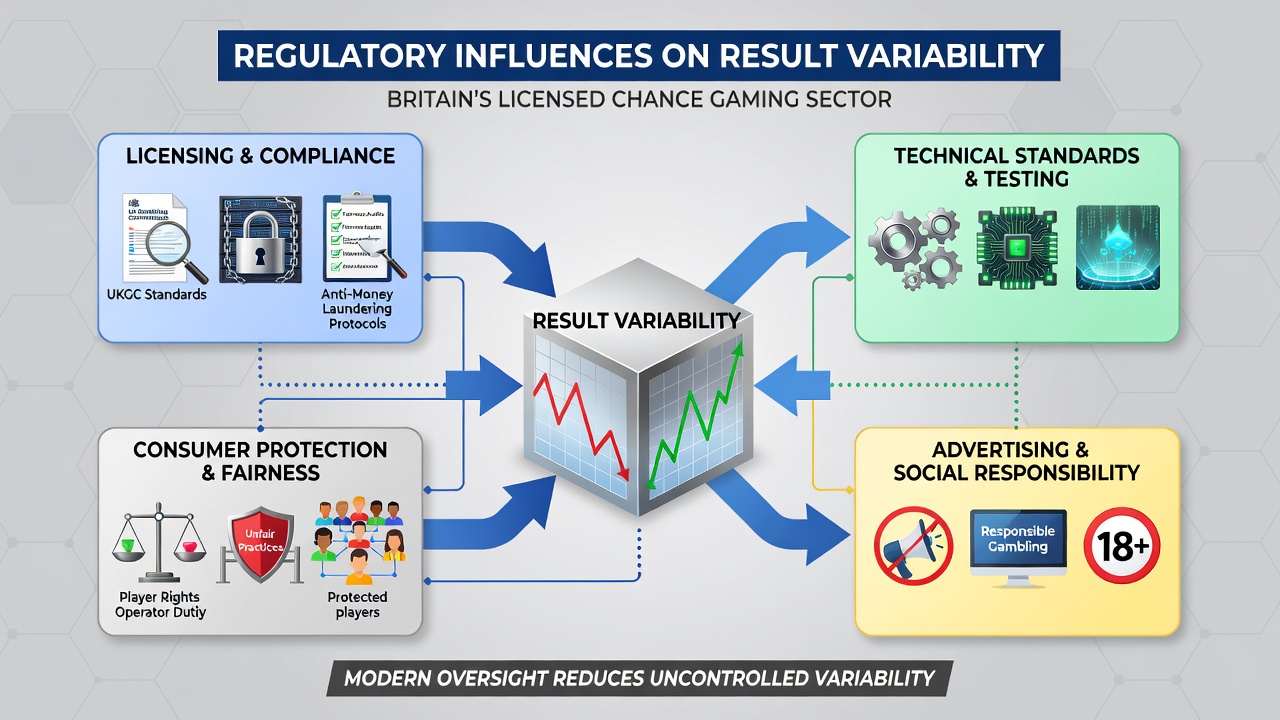
Figures from academic analyses reveal that certified systems exhibit lower coefficients of variation in payout sequences compared with unregulated alternatives, a pattern that holds across multiple jurisdictions with comparable oversight. Those who've examined archived test reports often discover that even minor tweaks to reel weights or bonus triggers undergo re-evaluation to prevent unintended spikes in outcome dispersion. The framework therefore maintains equilibrium between player engagement and statistical predictability without eliminating the core uncertainty that attracts participants.
Upcoming Adjustments Effective August 2026
New technical standards scheduled for August 2026 introduce enhanced requirements for live monitoring of result streams, requiring operators to flag sessions where variance exceeds pre-approved bands. These measures build on existing certification by adding real-time reporting layers that capture deviations earlier in the operational cycle. Research from the Australian Gambling Research Centre suggests that parallel monitoring programs in other markets have further compressed extreme result clusters, producing datasets that regulators can use to refine future guidelines.
Implementation will involve updated software modules that log distribution metrics at granular intervals, allowing authorities to compare live performance against baseline models with greater precision. Industry records show that similar phased rollouts in prior years led to incremental tightening of acceptable volatility ranges, which translated into steadier outcome patterns across the licensed fleet. The changes align with broader efforts to balance commercial viability against consumer protection metrics, though the precise numerical thresholds remain under final review as of mid-2025.
Comparative Data from International Frameworks
British standards share structural similarities with oversight models in other regions, where RNG certification and RTP documentation also constrain result variability. Reports compiled across European and North American markets demonstrate that jurisdictions enforcing annual re-testing achieve tighter clustering around mean outcomes, reducing the frequency of outlier sessions. This convergence allows analysts to track how regulatory stringency correlates with measurable stability in payout distributions over multi-year periods.
One study revealed that markets adopting unified testing protocols saw a 12 percent reduction in variance-related complaints within the first two years of enforcement, highlighting the practical impact on operational consistency. Those frameworks continue to evolve through iterative updates that incorporate fresh statistical evidence, ensuring that variability controls remain responsive to technological advances in game design.
Conclusion
Regulatory structures in Britain's licensed chance gaming sector function as primary determinants of result variability by embedding statistical limits into every stage of game development and operation. Certification, ongoing audits, and the forthcoming 2026 monitoring enhancements collectively maintain outcome distributions within defined parameters while preserving randomness. Evidence from multiple sources confirms that these influences produce consistent patterns across licensed products, shaping both short-term fluctuations and long-term averages in ways that reflect deliberate policy choices rather than market forces alone.